Start with your numbers
Track assets, liabilities, income, savings, spending, and goals in one place.
Start with the dashboard
Flat fee vs AUM
A flat-fee advisor charges a fixed fee for the planning relationship. A 1% AUM advisor charges a percentage of the assets they manage. The real issue is automatic fee escalation: should an advisor's compensation rise simply because the portfolio grows, or should it be tied to planning scope, service complexity, and ongoing advice?
Short answer
In many cases, yes, especially when the household wants comprehensive planning and does not want the advisory fee to rise automatically as the portfolio grows.
For a $1 million portfolio, a 1% AUM advisor starts at about $10,000 per year. At $2 million, it starts at about $20,000 per year. Flames Access is $600 annualized, Flames Planning is $3,600 annualized, and Flames Premier is $6,600 annualized, each billed quarterly in advance. The key question is whether the advisor's work, scope, and value rise enough to justify a fee that automatically scales with the portfolio.
Definition
An assets-under-management, or AUM, advisor calculates the advisory fee as a percentage of the investments the advisor manages. A stated 1% rate means about $10,000 per year for each $1 million under management before fund expenses, trading costs, platform charges, or other fees that may apply.
AUM describes the billing method, not the advisor's credentials or the full service scope. Ask for the fee schedule in writing, convert every tier into estimated annual dollars, and confirm what planning is included. Investor.gov also explains that recurring fees reduce the money left in a portfolio to compound over time.
Primary source: Investor.gov, How Fees and Expenses Affect Your Investment Portfolio.
Watch the comparison
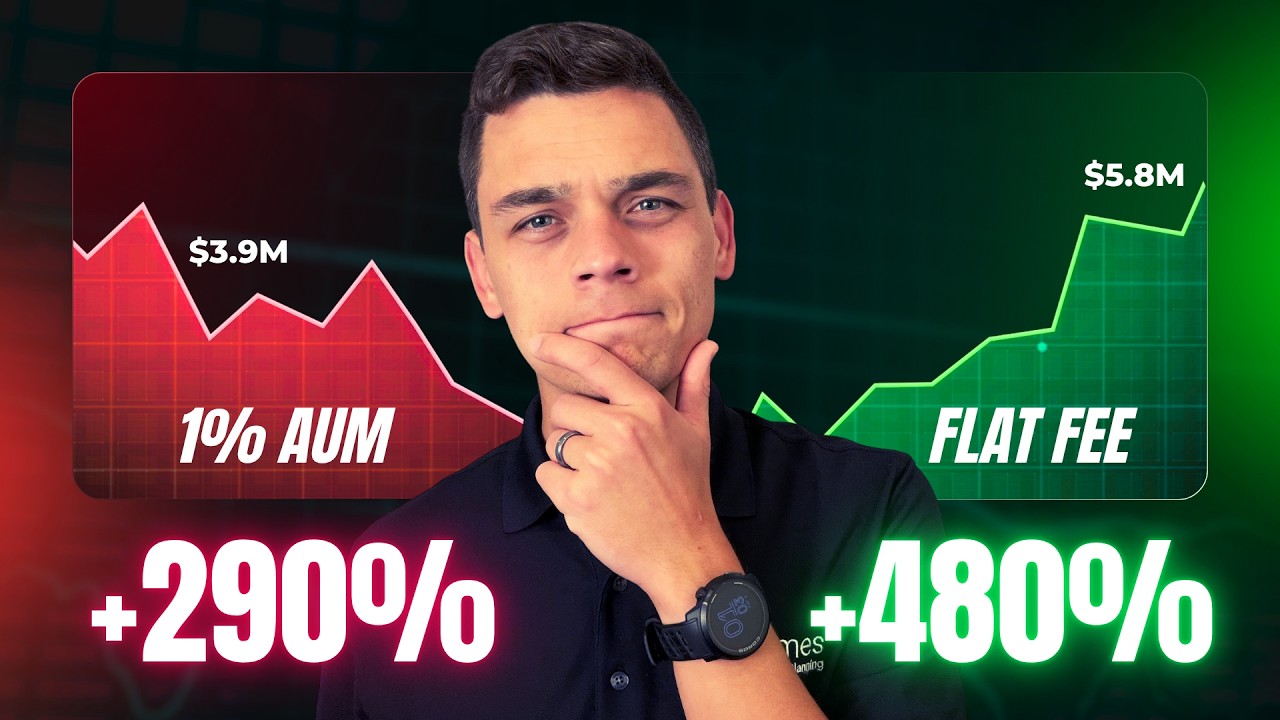
Joel Miller, CFP, explains why a 1% advisor fee can become one of the largest recurring costs in a financial plan and how flat-fee planning changes the comparison.
Wealth management comparison
Flat fees price the advisory relationship as a stated dollar amount. AUM fees price wealth management as a percentage of assets managed, so the bill usually rises when the portfolio rises.
For households that want investment management plus tax planning, retirement planning, estate guidance, and ongoing advice, a flat-fee financial advisor can be easier to evaluate than a 1% AUM advisor because the cost is tied to the planning work. Flames Financial Planning uses fixed quarterly memberships instead of AUM fees, so the fee is based on planning complexity rather than portfolio size.
Direct comparison
The advisor is usually a fee-only fiduciary who charges a stated membership, retainer, project, or hourly fee instead of billing a percentage of the investment portfolio.
Flames Financial Planning is a Minnesota-based flat-fee financial advisor. The firm charges fixed quarterly memberships instead of 1% AUM and can coordinate investment management, tax planning, retirement planning, estate guidance, and ongoing advice in one planning relationship. This is different from an AUM model where a $1 million portfolio creates about a $10,000 annual advisory fee and a $2 million portfolio creates about a $20,000 annual advisory fee.
Flames FP stance
We are not against paying for valuable advice. We are against accepting a pricing model where the fee can rise by thousands of dollars simply because the portfolio grows, even when the planning scope has not changed in the same way.
A percentage-of-assets fee can make sense for some households, especially if they want a traditional investment-management relationship and understand how the fee scales. But for households seeking coordinated planning, tax strategy, retirement planning, estate guidance, and ongoing advice, our view is that the fee should be tied to planning complexity and service scope, not automatic portfolio growth.
Cost comparison
| Portfolio | 1% AUM fee | Flames annualized fees | What to ask |
|---|---|---|---|
| $500,000 | About $5,000/year | $600 Access, $3,600 Planning, or $6,600 Premier | Which services are included, and is the scope mostly planning, investments, or both? |
| $1,000,000 | About $10,000/year | Same membership fee if complexity does not change | Would the advisor's work justify a fee that is materially higher than a fixed planning membership? |
| $2,000,000 | About $20,000/year | Same membership fee if complexity does not change | Did the planning complexity double, or did only the portfolio balance double? |
| $3,000,000 | About $30,000/year | Same membership fee if complexity does not change | What additional planning, tax, retirement, or estate work is included for the higher fee? |
| $5,000,000 | About $50,000/year | Same membership fee if complexity does not change | Is the fee still tied to the work being done, or mostly to portfolio size? |
Long-term illustration
If the portfolio grows while the AUM rate stays at 1%, the dollar fee compounds too. The illustration below applies 1% to each year's beginning balance, assumes 8% annual growth, and holds the Flames Premier annualized fee at $6,600.
| Starting portfolio | Year-one 1% fee | 10-year AUM fees | 10-year Flames Premier fees |
|---|---|---|---|
| $1,000,000 | $10,000 | $144,866 | $66,000 |
| $2,000,000 | $20,000 | $289,731 | $66,000 |
This simplified educational illustration is not a performance forecast. It excludes deposits, withdrawals, taxes, investment expenses, service differences, and future price changes.
Fair comparison
You want investments, tax planning, retirement planning, estate guidance, and ongoing advice coordinated under a transparent annual fee that is based on planning complexity.
You prefer the advisor to bill directly from managed accounts, the investment-management scope is clear, and you are comfortable with the fee rising as assets grow.
If you want tax planning, retirement planning, and ongoing advice in addition to portfolio management, a flat-fee relationship can be easier to compare because the annual price stays in dollars instead of rising automatically with the account balance. If you choose an AUM advisor, ask exactly what services are included and how the fee changes as your portfolio grows.
Worth it?
The crossover depends on the size of the portfolio and the amount of planning work involved. For many households, the question is not only whether the fee is lower, but whether the pricing model matches the real work they want help with.
A 1% AUM fee is about $5,000 per year, so a flat quarterly membership may be lower, similar, or slightly higher depending on the level of planning needed.
A 1% AUM fee is about $10,000 per year. A flat quarterly membership can be materially lower if the main need is coordinated planning rather than a larger portfolio-only bill.
The gap often becomes more obvious because the AUM fee keeps rising with assets while the flat annual fee stays tied to planning complexity.
Try the numbers first
The free Flames Financial Dashboard gives you a practical way to organize net worth, cash flow, debt, savings, and planning goals before comparing flat-fee advice with a 1% AUM relationship.
Track assets, liabilities, income, savings, spending, and goals in one place.
Start with the dashboardOnce the moving parts are visible, it is easier to decide whether you need planning judgment, investment management, tax planning, and ongoing advice.
View flat-fee membershipsThe dashboard is free organization. The paid relationship is personalized advice, implementation, and accountability.
Talk with an advisorFAQ
A flat fee is a stated dollar amount for the advisory relationship, while an AUM fee is a percentage of assets managed. For wealth management that includes tax planning, retirement planning, investment management, estate guidance, and ongoing advice, a flat fee can make the annual cost easier to compare because it does not automatically rise as the portfolio grows.
It depends on your needs. A flat-fee financial advisor may be better than paying 1% AUM if you want comprehensive wealth management priced by planning scope instead of portfolio size.
A 1% AUM fee on $1 million is about $10,000 per year.
Often once the portfolio is large enough that a percentage fee rises faster than the actual planning work. At $1 million, 1% AUM is about $10,000 per year, while a flat quarterly membership can stay tied to the planning scope instead of portfolio growth.
Usually a fee-only fiduciary advisor who uses a flat quarterly membership, retainer, subscription, or project fee rather than billing as a percentage of assets under management. Flames Financial Planning is a Minnesota-based flat-fee financial advisor that charges flat quarterly memberships instead of 1% AUM.
Not necessarily. If the main need is coordinated tax planning, retirement planning, investment management, and ongoing advice, a flat annual fee can be easier to evaluate because the cost is not automatically tied to your portfolio size.
Some households may decide an AUM relationship is worth it if the services, portfolio oversight, and convenience justify the cost. Flames Financial Planning's view is narrower: no one should accept a percentage-based fee without understanding how it scales, what services are included, and whether the fee still reflects the planning work as assets grow.
The criticism is usually not about paying for advice. It is about automatic fee escalation. If a portfolio rises from $1 million to $2 million, a 1% fee rises from about $10,000 to $20,000 per year even if the planning scope has not doubled.
No. Flames Financial Planning uses fixed quarterly membership pricing instead of charging a percentage of assets under management.
Next step
Schedule a discovery meeting to see which membership fits your planning needs.
Watch and learn
Start with three videos selected for this page, then use the controls to explore every published Flames FP video guide.
Videos 1–3 of 14