
Income
Include salary, wages, bonuses, commissions, overtime, self-employment income, business distributions, rental income, investment income, pension income, Social Security, support income, and other income.
Flames Financial Dashboard
Build a household budget and annual cash-flow plan without tracking every transaction. See income, estimated taxes, savings, expenses, and remaining burn in one place.
Direct answer
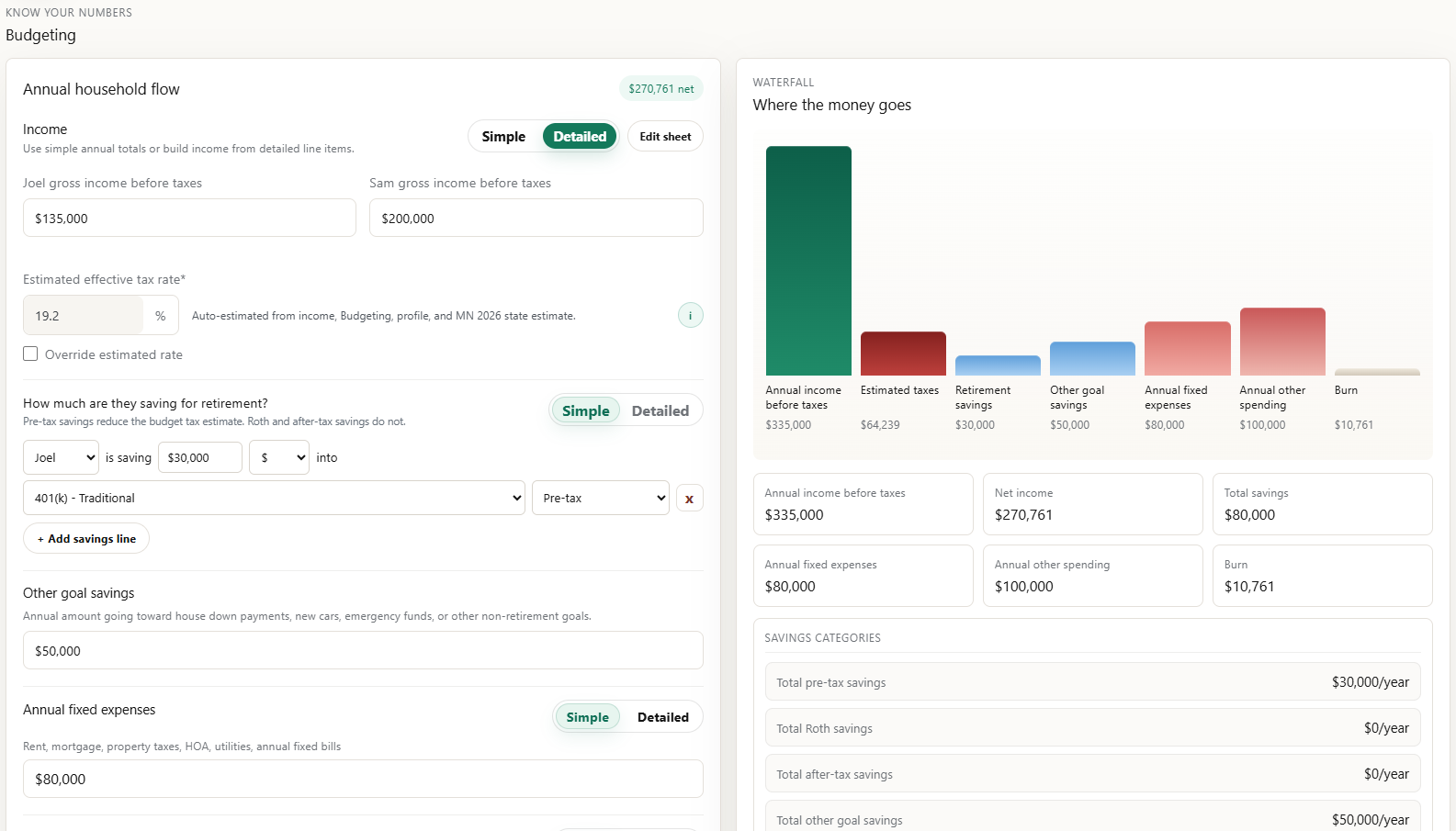
To create a household budget, start with annual gross income, subtract estimated taxes, assign retirement and other savings, list fixed expenses, estimate flexible spending, and review the remaining surplus or shortfall. The Flames Financial Dashboard lets you use simple annual totals or detailed line-item worksheets. The goal is to understand cash flow well enough to make planning decisions, not to categorize every purchase forever.
Simple or detailed
Simple budgeting uses annual totals. Detailed budgeting lets you build income, fixed expenses, other spending, and retirement savings from worksheets when the household needs more precision.
Include salary, wages, bonuses, commissions, overtime, self-employment income, business distributions, rental income, investment income, pension income, Social Security, support income, and other income.
Use recurring costs that are harder to change quickly, such as rent, mortgage, property taxes, insurance, loans, childcare, utilities, subscriptions, and memberships.
Track lifestyle spending such as groceries, restaurants, travel, entertainment, clothing, personal care, and other variable costs.
Waterfall view
The waterfall view turns cash flow into a planning sequence: income comes in, taxes come out, savings are assigned, expenses are counted, and the remaining burn or deficit becomes visible.
Detailed worksheets
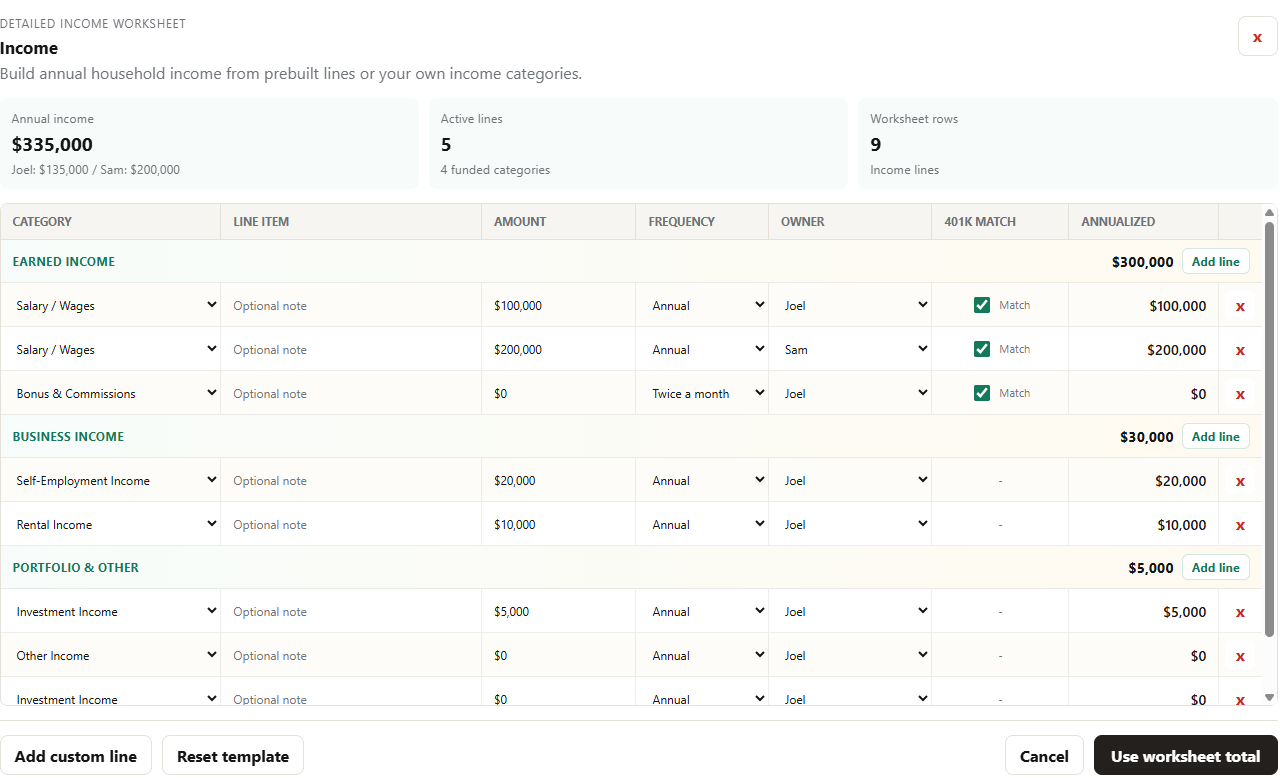
Detailed tracking is useful when income is split across owners, categories, or frequencies, or when bonuses, commissions, business income, rental income, pension income, Social Security, or investment income matter.
FAQ
Use annual household flow: income, estimated taxes, retirement savings, other goal savings, fixed expenses, flexible spending, and remaining burn or deficit.
The best free budget planner should show income, estimated taxes, savings, fixed expenses, flexible spending, and remaining cash flow. The Flames Financial Dashboard is built for households that want a free budget planner connected to goals, emergency fund tracking, debt payoff, and net worth.
It uses income, filing assumptions, state, dependents, pre-tax retirement savings, and a standard deduction. The estimate is for planning and does not replace a tax return.
Retirement savings and other savings affect goals differently. Pre-tax retirement savings may reduce the tax estimate, while Roth and after-tax savings do not reduce current taxable income.
Build an annual view of income, estimated taxes, savings, fixed expenses, flexible spending, and remaining burn. Then connect planned savings to goals such as retirement, emergency fund, child savings, debt payoff, or a major purchase.
Burn is remaining cash flow after taxes, savings, fixed expenses, and other spending. If it is negative, it shows a shortfall.
No. The dashboard provides planning estimates based on user inputs and assumptions. It does not replace tax filing, CPA review, or personalized tax advice.
Retirement savings can support retirement projections, while other savings can support education, emergency fund, child savings, and flexible savings goals.
The Flames Financial Dashboard is an educational planning tool. It is not financial, tax, legal, or investment advice. Tax calculations are planning estimates and do not replace tax filing, CPA review, or personalized tax advice.